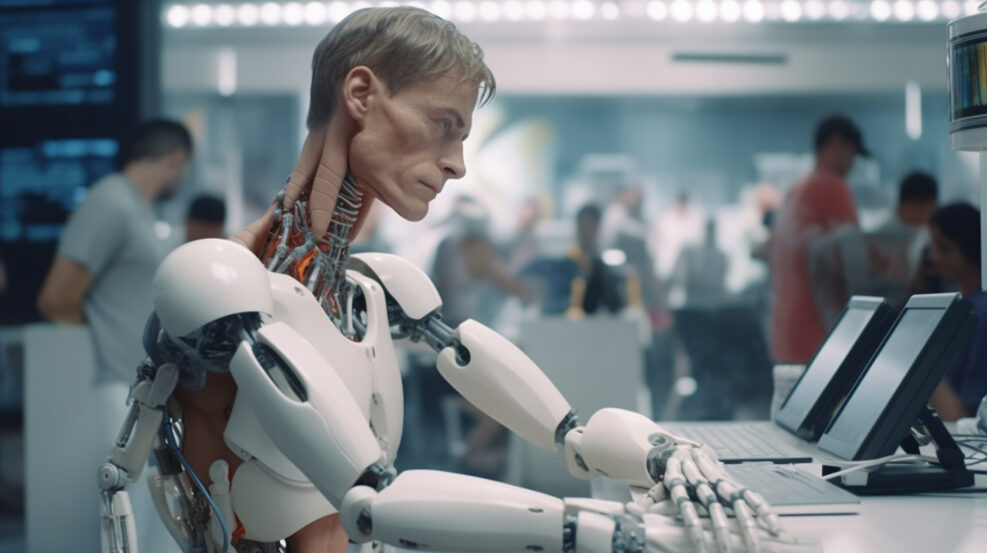
Harari, Humans, Algorithms, and AI
A futurist’s warning: AI may soon redefine the boundaries of human agencyThis anthropological starting point assumes the similarity of humans to computers, not the other way around.
Read More ›This anthropological starting point assumes the similarity of humans to computers, not the other way around.
Read More ›
When dictators adopt transhumanism, it won’t just be Ray Kurzweil trying to upload himself to digital immortality. There will be a very dark side.
Read More ›
Host Robert J. Marks welcomes back Walter Myers to discuss the philosophical concept of the Ship of Theseus, a paradox about whether an object remains the same after all of its original components have been gradually replaced. Myers explains the history and origins of the paradox and explores how it relates to questions of personal identity, the mind-body problem, and Read More ›

Johnson’s views on AI sound crazy, but they reflect a burgeoning hope that computerized superintelligence will somehow solve all the enigmas of existence.
Read More ›
Is the mind the same thing as the brain? Recently, we’ve been tackling this question known as the mind-brain problem with several of the contributing authors to our recent book Minding the Brain. In a similar fashion, we can also ask if there’s more to the human person than just our bodies. This week we have neurosurgeon Michael Egnor talking about Read More ›

“The product is certified ready for human testing.” I’m not quoting Elon Musk in relation to Neuralink. That’s the line from the fictional Norman Osborn in Sam Raimi’s original Spider-Man movie, starring Tobey Maguire, Kirsten Dunst, and the green maniac himself, Willem Dafoe. I’ve seen this movie dozens of times, so maybe it’s due to the weird fact that twenty-plus years after this film hit the scene, we now live in a world where big science organizations like Osborn’s Oscorp seem to be dealing with similar conflicts that ultimately produced the iconic Green Goblin. Not that Elon Musk or Sam Altman are going to start flying around on saucers and terrorize New York City. But they are eager to rush Read More ›
Tech investors and entrepreneurs are self-fulfilling old prophecies. One also thinks of Fahrenheit 451 by Ray Bradbury, a dystopian classic published in 1953.
Read More ›
The Nazis were keen on creating a superhuman race with unsurpassable physical, intellectual, and (ironically) moral qualities.
Read More ›
The book is prophetic, merging two pertinent issues into one speculative tale: euthanasia and transhumanism.
Read More ›
AI’s greatest threat may not be its sophistication, but our own over-reliance on it. As a technology, it has its uses and benefits. As a religion, it fails.
Read More ›
The first time I watched Westworld, I remember enjoying it, but upon revisiting the series, my opinion of it has dropped a great deal. There are a variety of problems. First, it’s a bait and switch. It teases the idea of showing how robots can come to life, and it plays with your expectations for most of the series. It even goes as far as to discuss theories like The Bicameral Mind, and The Turing Test. Then, in the last episode, it confirms what the viewer has been slowly growing to suspect. The robots had been coming to life the entire time, and Ford had been wiping their memories. The show says that Ford programmed the robots to experience everything Read More ›

Since its release in July, Barbie has proved as controversial as it has popular. Its joint release alongside Oppenheimer has had movie theaters across the country teeming with “Barbenheimer” fans, those zealous people who watched both movies on the same day in an unprecedented feat of pink glitz and existential dread. But what is Barbie about? Is it a takedown of the patriarchy, a gentle comedy, or something a bit more subtle and powerful? The reviews have ranged between harsh critique and lavish praise. With the flood of commentary, though, have most people missed a central and yet subtle point? Elayne Allen, writing for Public Discourse, offers an alternative interpretation of the movie which might have bypassed the imaginations of Read More ›
Once again, biotechnology is racing ahead of our capacity to intellectually digest what is happening.
Read More ›
Dr. Jay Richards, a Senior Fellow at Discovery Institute and a friend of the Walter Bradley Center, which publishes Mind Matters, spoke recently at the Acton University conference, discussing both transhumanism and AI. Transhumanists, Richards notes, look at the scope of “cosmic evolution,” see a kind of increasing complexity among the human race, and speculate the next dramatic step: achieving immortality through a mixture of genetic engineering, nanotechnology, and artificial intelligence. Richards described the transhumanist ideology as “anti-human,” but cautioned against having a reactionary response to all new technologies that seem to be involved in transhumanism’s vision, noting that some of them, when analyzed specifically, could have benefits (such as AI). The underlying philosophy of transhumanism, however, should be rejected. Read More ›

The movie Poor Things, starring Emma Stone, Willem Dafoe, and Mark Ruffalo, is the story of an “unorthodox” scientist who brings a girl, Bella Baxter (Stone), back to life. Baxter must learn how to navigate the world given her unwieldy demeanor and the uncoordinated connection between her brain and body. It looks to be a pretty close re-interpretation of Mary Shelley’s classic science fiction novel Frankenstein. Whether it will get even close to investigating Shelley’s key questions and insights remains to be seen, of course. Interestingly, the scientist (Dafoe) has a deformed face that looks like it was stitched together piece by piece, similar to popular renderings of Frankenstein’s monster. You can watch the trailer here:

This is a conversation from a year ago but nevertheless remains radically pertinent today. Paul Kingsnorth and Mary Harrington, both who have written on various modern trends to try and transcend bodily limits, sat down on the Rebel Wisdom YouTube channel to have a chat. Both have written for the online magazine UnHerd, but up until this point, had never interacted with each other. Kingsnorth is a former environmentalist who became disillusioned with the movement and eventually converted to Orthodox Christianity. He is also a novelist and currently lives a simple life in Ireland. Harrington is a contributing editor of UnHerd and writes on feminism, politics, and other pressing cultural issues. Both believe that the urge to throw off human Read More ›

For today’s featured video from COSM 2022, watch Babak Parviz, Vice President at Amazon, lead a discussion on synthetic biology, the multi-disciplinary field that applies engineering principles to redesign biological systems for new purposes. The panel focuses on bio-medical technologies that hold great promise for curing diseases and even counteracting human aging. For more material on the topic, see this piece on Altos Labs and their work on bio-longevity. Part of their project also involves artificial intelligence research: Altos Labs’ vision isn’t too far removed from that of the transhumanists who want to computerize human consciousness. For them, however, longevity is a junior varsity goal — what we really need is a way to live forever. Harrison quips at the Read More ›

In the era of scientific enlightenment, progress, and technological sophistication, “magic” might be the last word one might use to describe the activity of modern Western culture. We live in an age of reason, not superstition. Right? The old world of myth, mystery, and religion is holed away in museums and cathedrals; these are relics of an admirable but outdated generation. After Reason In a fascinating new article from The New Atlantis, writer Tara Isabella Burton writes about the “postrationalists,” an Internet subculture disillusioned with the technocratic rationalism of Silicon Valley and in search of a sense of the mystical and divine. “Reason,” or the modern conception of it, has left the postrationalists disappointed. Neither, however, are they flocking to Read More ›
Neuralink, Elon Musk’s bio-engineering company that launched in 2016, received approval from the FDA to begin human experiments with its brain implant technology. The company has struggled for years to gain such approval, and up to this point, has been investigated on occasion for potential dangers the implants might pose. Musk, however, is optimistic about the technology, and thinks it may have the potential to heal a range of disorders and illnesses including autism, depression, and schizophrenia. However, the organization is being “probed” by various governmental agencies. According to a Reuters report, The Department of Transportation is separately probing whether Neuralink illegally transported dangerous pathogens on chips removed from monkey brains without proper containment measures. Neuralink is also under investigation by the U.S. Department Read More ›

[Warning: Spoilers Ahead] The highly-watched HBO show “Succession” tells the story of a media empire ruled by a cantankerous, manipulative businessman, Logan Roy, and his three children who are hardly any better. Most of the show is a commentary on the corrupting effects of wealth and the power dynamics involved in the media empire’s core leadership. In the dramatic fourth season, Logan Roy dies from what seems to be a stroke while he’s flying to Norway to discuss a giant merger deal with another media mogul. From there, the three Roy children, Kendall, Roman, and Shiv (along with a half-brother Connor who doesn’t care as much about his place in the kingdom) scramble to figure out the leadership, direction, and Read More ›